Contact
Gartner
Reports
Colorful paint swatches in fan arrangement logo

Fair Cost Allocation

Introducing a Globally Unique Capability

Rethinking Cost Distribution in Logistics

Accurately assigning costs in logistics has long been a challenge. Traditional cost allocation methods rely on estimates rather than precise calculations, leading to inefficiencies, misallocated expenses, and a fuzzy understanding of resource usage. The result is an imbalance—some shipments are assigned undue effort while others deliveries are underestimated for their burden on operations, creating inaccuracies that ripple through supply chains.


EPG’s Greenplan introduces Fair Cost Allocation, a globally unique algorithm developed in collaboration with discrete mathematicians from the University of Bonn. This breakthrough calculation is the first in the world to precisely compute the financial and environmental costs of each shipment, ensuring sharpened financial planning, smarter shipment assignments, and greater operational efficiency.


Contact Our Routing Experts

Ready to Redefine Cost Analysis and Management?

Number of Vehicles
We are happy to calculate your savings potential. Find out more in a no-obligation consultation in which we take your desired focus into account. By submitting your data, you consent to the details you have provided on this form being processed. Your data is processed to respond to your query. I accept the privacy policy.

Learn more in our FREE "Fair Allocation Technical Booklet"

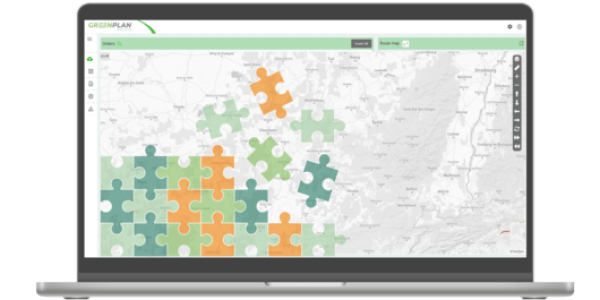
Laptop displaying map with colorful puzzle overlay.

Traditional cost estimation strategies fall short. Most logistics providers allocate costs based on historical data or broad estimates. However, not all shipments carry the same cost burden, and failing to account for these differences leads to inflated operational expenses and cost assignment disparities.

Delivery costs are not uniform. A shipment requiring express delivery to a remote location incurs significantly more costs than one traveling a short distance with flexible timing. Without precise cost allocation, logistics providers struggle to balance cost distribution fairly across all shipments.

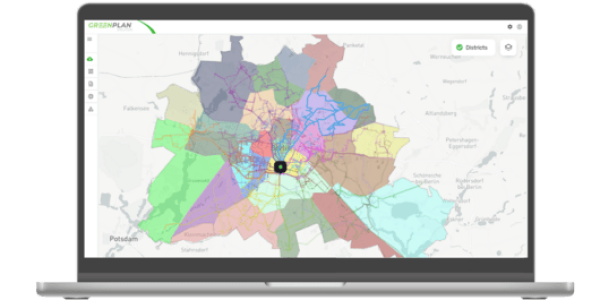
Color-coded map on laptop screen

But economic costs aren’t the only ones that count anymore – businesses must consider the environmental toll of their deliveries as well. With increasing regulatory and corporate focus on sustainability, companies need to accurately measure and distribute carbon emissions per shipment. Traditional models do not account for the environmental impact of individual deliveries, making it difficult to track and report emissions effectively.

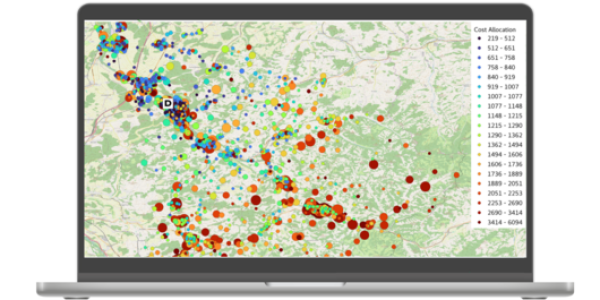
Digital map with colorful data points on laptop

Fair Cost Allocation removes guesswork from cost distribution by applying advanced mathematical modeling to logistics operations. It ensures that each shipment is assigned a fair and transparent share of the total delivery cost, both financially and environmentally.

Key Features and Benefits

➔ Precise Financial Cost Calculation

The algorithm assesses the resource consumption of each shipment, taking into account distance, urgency, delivery density, and other operational constraints. This results in cost allocations that reflect actual expenses rather than estimations.

➔ Penalty Reduction for Delays and Drops

By considering cost allocation in the context of shipment prioritisation, Greenplan minimises penalties associated with delayed or unfulfilled deliveries. The system identifies which shipments can be adjusted with the least operational impact.

➔ CO₂ Emissions Tracking and Allocation

Environmental impact is calculated alongside financial cost, allowing logistics providers to track and assign emissions responsibility per shipment. This is particularly valuable for companies focused on sustainability goals, carbon caps, and transparent reporting.

How the "Happy Nucleolus" Model Ensures Fairness

The core of Fair Cost Allocation is built on the “Happy Nucleolus” model, a concept from cooperative game theory designed to ensure fair cost-sharing. Developed by Prof. Dr. Jens Vygen and his team at the University of Bonn, this approach ensures that no group of shipments is overburdened in a cost-sharing scenario.

Digital map with colorful data points on laptop

The algorithm compares the cost of service for different shipment groups:

•   If a shipment’s cost is lower within the assigned network than if it were delivered alone, it benefits from the network and remains “happy.”
•   If a shipment’s cost burden is disproportionately high, the algorithm redistributes costs to maintain fairness.


This method prevents cross-subsidisation, ensuring that every shipment is fairly priced based on its actual impact on the network.

Greenplan

Who Benefits from Fair Cost Allocation?

Third-Party Logistics (3PL) Providers – Ensure transparent, fair cost-sharing among clients while reducing inefficiencies in network planning.

Retail and E-Commerce – Improve pricing models and last-mile delivery efficiencies by aligning shipping costs with actual resource usage.

Post and Parcel Operators – Optimise multi-network parcel assignments to lower costs while maintaining service levels.

Smarter, More Transparent, and More Sustainable Logistics

Fair Cost Allocation is already in use with Greenplan customers, and the results are clear: improved cost transparency, optimised shipment assignments, and more sustainable logistics operations.

To learn more about how Fair Cost Allocation is transforming delivery worldwide, contact us today.


Learn more in our Fair Cost Allocation Technical Booklet

Efficient and flexible warehouse management

Searching for the WMS solution that fits you best?