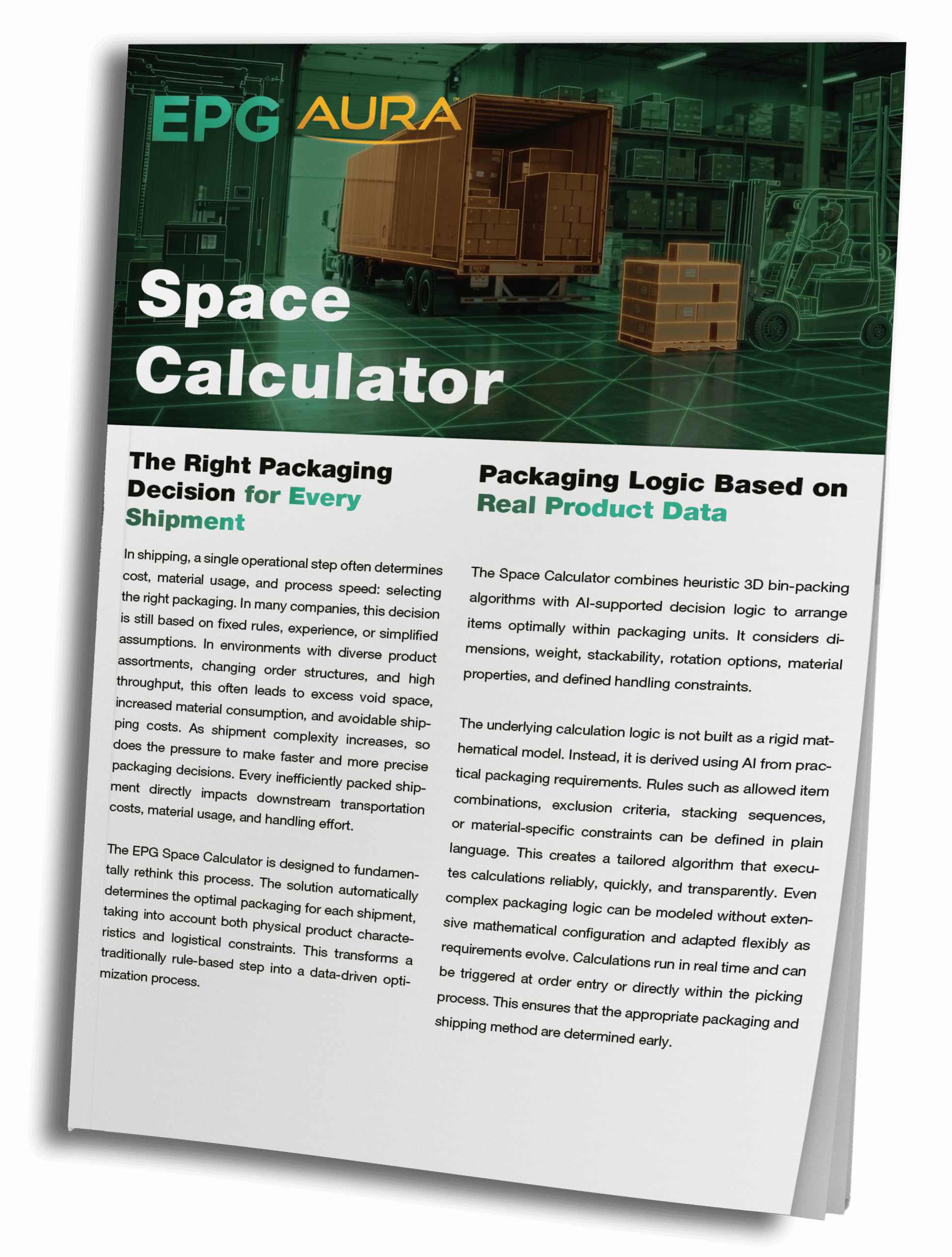
Companies with heterogeneous product ranges, changing order structures, and high shipping volumes often rely on fixed rules or manual experience when choosing packaging, pallets, or loading spaces. This can result in unused air volume, poorly utilized transport units, higher material consumption, and avoidable costs.
The EPG Space Calculator, powered by AURA, turns packaging, palletizing, and loading decisions into a data-based optimization process. It automatically calculates the best possible arrangement of items or packages within cartons, pallets, containers, or truck loading spaces based on real article data, weight, stackability, rotation options, handling requirements, and logistics restrictions. This enables faster, more consistent, and more cost-efficient decisions while improving space utilization across the entire shipping process.
Automatically selects the best-fit packaging or shipping unit for every order.
Accelerates packing and loading decisions in fast-moving environments.
Reduces costs by aligning packaging and load dimensions with transport requirements.
Reliably handles varying item sizes, weights, and material characteristics.
Maximizes available capacity in containers, trailers, and trucks.
Creates more consistent, data-based decisions across operations.
Reduces empty space, packaging material usage, and wasted transport capacity.
For Microsoft, the real value does not lie solely in the availability of technological infrastructure, but in the ability to derive concrete operational relevance from it
"A company becomes an AI Frontier Firm when AI is no longer limited to isolated pilot projects, but systematically creates competitive advantage. That is exactly what we see at EPG."
Patrick Schidler, Sales Director Cloud & AI for Midmarket DACH at Microsoft
Here you’ll find answers to the most common questions about EPG AURA™: its purpose, capabilities, and how it supports smarter, AI-powered supply chain execution.
The EPG Space Calculator automatically calculates the best possible arrangement of items or packages within cartons, pallets, load carriers, containers, or truck loading spaces. Based on real article data and logistics requirements, it helps reduce empty space, material usage, and avoidable transport costs while improving the utilization of available packaging and loading space.
The solution considers all relevant product, packaging, and logistics factors, including dimensions, weight, stackability, rotation options, material properties, handling requirements, customer-specific packing instructions, and defined restriction rules. It can also take factors such as permitted item combinations, exclusion rules, loading requirements, weight distribution, and transport-related constraints into account.
The Space Calculator can be used at different stages of the logistics process, including order entry, picking, goods receipt, packing, palletizing, and truck or container loading. It can be integrated into existing WMS, OMS, and shipping processes via standardized APIs, allowing companies to improve space utilization without disrupting established workflows.
Companies benefit from better utilization of cartons, pallets, containers, and loading spaces, lower material and transport costs, faster decision-making, and more standardized packing, palletizing, and loading processes. In addition, the solution creates greater transparency through measurable data such as void space, volume utilization, and packing efficiency, supporting continuous optimization across shipping operations.
Searching for the WMS solution that fits you best?
We are proud that the EPG AURA Observer won the LogiMAT “Best Product 2026” award! Read this exclusive reprint to find out how our AI solution is shaping the future of logistics.