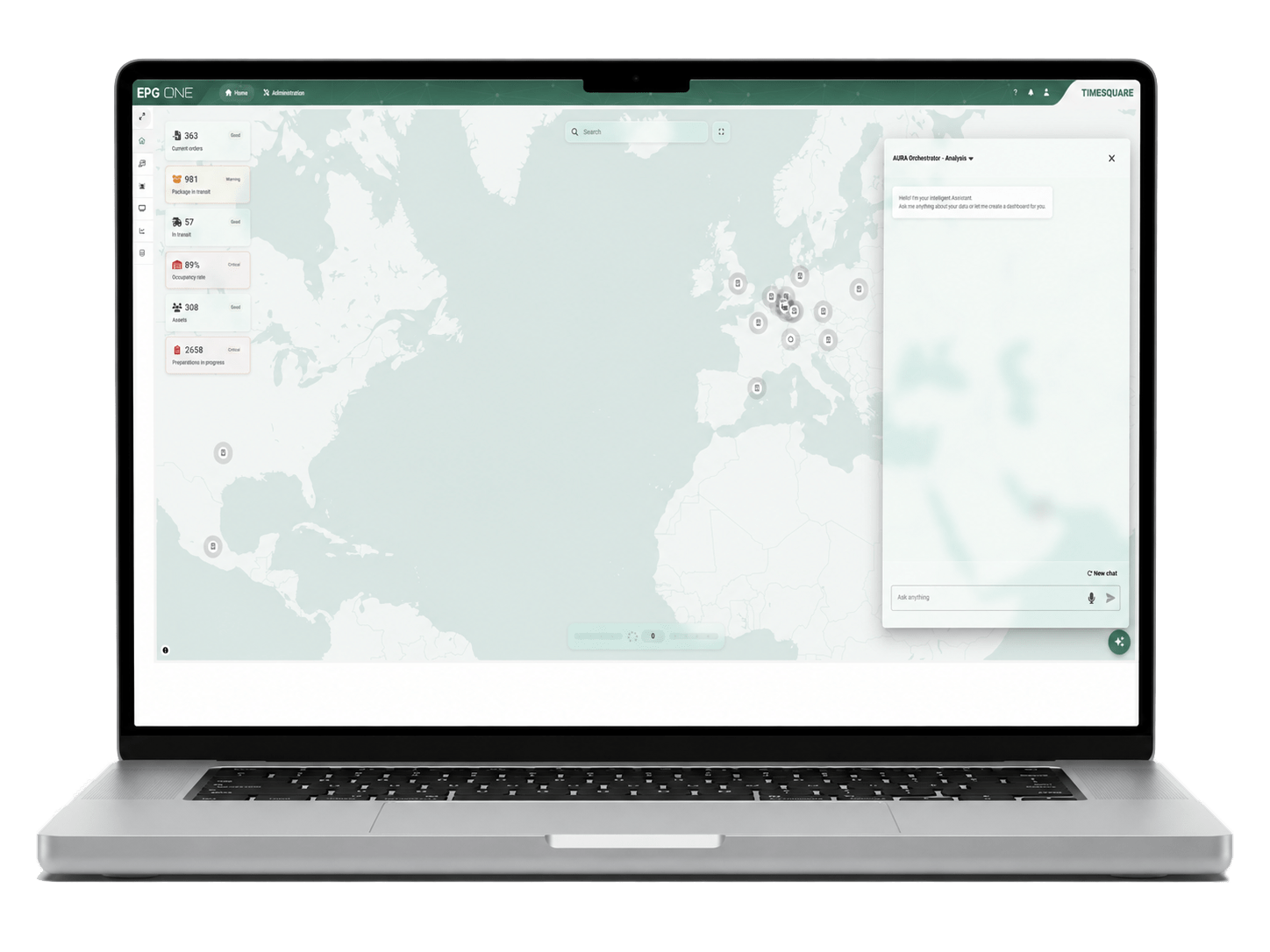
Real-Time AI Orchestration for Supply Chain Operations
In complex logistics environments, operational decisions are often made under time pressure, across multiple systems, and without full visibility into dependencies or downstream impact. This creates delays, weak prioritization, and unnecessary friction in daily execution.
AURA Orchestrator addresses this by continuously connecting real-time information, process status, and operational context, helping teams evaluate situations faster, align actions more effectively, and maintain control across live supply chain operations. Depending on the use case, decisions and workflows can be automated end to end or supported through a human-in-the-loop approach, allowing users to validate, adjust, or approve recommendations whenever needed.
Key Benefits at a Glance
Faster decisions in dynamic situations:
Bring together the operational context needed to assess situations quickly and act with greater confidence.
Better prioritization across processes and resources:
Make dependencies and downstream impact visible so teams can focus on what matters most.
More stable day-to-day execution:
Identify and address disruptions earlier before they spread across connected processes.
Stronger coordination across systems:
Align actions more effectively where multiple workflows and applications interact.
No complex development or configuration required:
Simply describe your goals and provide them to the AI as decision guidelines—without the need for extensive development or complex setup.
A scalable path toward intelligent orchestration:
Expand from guided decision support to increasingly automated coordination over time.
Intelligent agents and capabilities working together
Augmented Orchestration
Specialized AI agents designed for specific enterprise functions
Augmented Orchestration supports operational teams with the context they need to make better decisions in live logistics environments. Priorities become clearer, dependencies more visible, and coordination more manageable where timing matters most.
Observer Agent
Monitors systems and detects anomalies in real-time
Communicator Agent
Handles multi-channel communication and coordination
Support Agent
Prepares, organizes, and makes data effectively usable for decision-making
Autonomous Orchestration
Advanced AI capabilities powering enterprise transformation
Autonomous Orchestration enables selected processes to be coordinated automatically based on real-time information and defined operational logic. Once conditions and priorities are set, decisions can be translated directly into execution.
Natural Language Processing
Advanced understanding of human language and intent
Computer Vision
Visual recognition and analysis for process automation
Predictive Analytics
Forecasting and optimization using machine learning
Example Use Cases for Orchestrator
See how AURA Orchestrator turns operational complexity into guided decision-making across live logistics environments. Product views and scenario-based examples show how priorities become visible, dependencies are connected, and actions can be aligned faster when conditions change.
Dynamic order prioritization in changing operational conditions.
Exception handling across connected process steps.
Resource and workload coordination in real time.
Cross-system decision support for operational teams.
Early detection of delay risks and response options.
Automated response to IVA-created events from camera vision.
Play Video
For Microsoft, the real value does not lie solely in the availability of technological infrastructure, but in the ability to derive concrete operational relevance from it
"A company becomes an AI Frontier Firm when AI is no longer limited to isolated pilot projects, but systematically creates competitive advantage. That is exactly what we see at EPG."
Patrick Schidler, Regional Sales Director Cloud and AI at Microsoft
Your Questions. Clear Answers.
Here you’ll find answers to the most common questions about EPG AURA: its purpose, capabilities, and how it supports smarter, AI-powered supply chain execution.
Does AURA Orchestrator replace existing execution systems?
No. It works across existing systems by adding contextual decision support above operational processes.
Can decisions remain under human control?
Yes. Companies define where decision support ends and where automated action begins.
Is full system integration required from the start?
No. Initial use cases can begin with selected data sources and expand step by step.
Which processes benefit most first?
Typical starting points are prioritization, exception handling, and coordination across connected workflows.


 Global
  English
  Español
  Português
  Deutsch
  English
  Français
  Italiano
  Español
  Nederlands
  Polski
  Čeština
  AE-English
  AU-English