Global
  English
  Português
  Deutsch
  English
  Français
  Italiano
  Español
  Nederlands
  Polski
  Čeština
  AE-English
  日本語
日本語  AU-English


- Tags AI assistant for logistics, AI for warehouse data, AI in warehouse logistics, AI in warehouse management, AI-powered data access in the warehouse, Conversational AI in logistics, Knowledge management in logistics, Natural-language access to data, Querying WMS data, Using AI to access enterprise knowledge
Modern warehouses generate and process more information than ever before. Inventory levels, order statuses, equipment conditions, error messages, and work instructions are recorded digitally and generally available. Yet day-to-day operations often tell a different story. As soon as an order stalls, a system generates an error message, or an unusual process situation occurs, the search for the right information frequently begins. It may be stored in the WMS, technical documentation, a support ticket, or the experience of individual employees. The real problem is therefore increasingly not a lack of data, but how quickly distributed information can be turned into a specific, reliable answer. AI-powered data access in the warehouse can make a significant difference. Using six clear questions, this blog post explains how AI can make distributed warehouse data and process knowledge more readily accessible in daily operations.
This is precisely where AI in warehouse logistics is changing the way people can interact with software and enterprise knowledge. Instead of first having to find the correct application, screen, or documentation, users can ask a specific question directly in natural language. This shifts the focus. What matters is no longer only what information a company possesses but whether that information is accessible at the right moment, in the appropriate context, and for the task at hand. Conversation Intelligence can therefore become a new interface connecting employees with system data and process knowledge. The following six questions illustrate its potential for warehouse logistics while also examining its critical limitations and requirements.
1. Is Making Information Digitally Available Enough?
Digitalization has significantly improved transparency in the warehouse. Inventory can be tracked in real time, order statuses are documented in the relevant systems, automation components provide status and error messages, and work instructions or technical documentation is generally available in digital form. Nevertheless, the availability of this information does not automatically mean that it can be used quickly in daily operations.
The reason is often that relevant information is generated and stored separately. A blocked order may be visible in the WMS, while the cause could lie within an automation component. A ticket may already exist for the reported malfunction, while the relevant work instruction is stored in a different application. Each piece of information may be accurate, yet still represent only part of the actual situation.
The ability to bring information together within its specific context is therefore becoming increasingly important. At the moment an issue occurs, employees are not concerned with how many systems contain relevant data. What matters to them is whether that data can quickly produce a clear answer to the question at hand. This is where the difference between digitally available information and genuinely usable knowledge begins.
2. How Does AI in the Warehouse Change the Starting Point?
Traditional software systems follow a clear logic. Anyone who needs a piece of information must know which application contains it, which screen is relevant, and how to narrow the search. This principle works, but it requires users to understand the structure of each system and know how to navigate it effectively. The more applications used in parallel, the greater the effort involved.
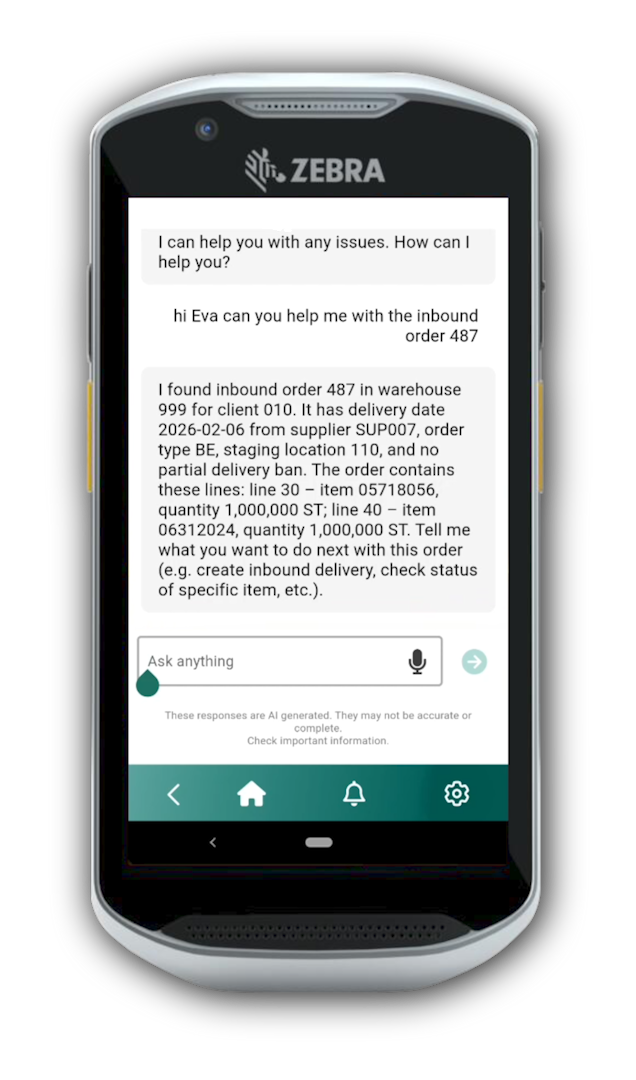
Conversation Intelligence reverses this logic. The starting point is no longer the system, but the specific question. Employees describe what they want to know in natural language, and the AI solution accesses the information sources authorized for that purpose. What changes most is the way existing information is accessed. The systems themselves remain in place, along with their functions and data structures. What is new is an additional layer created by the AI warehouse assistant that can make different sources accessible through a shared form of interaction. In daily operations, this primarily means that employees need to know less about where information is stored and can focus more closely on the answer they need to complete their next task.

3. What Information Needs to Be Connected for an AI assistant in logistics?
The value of Conversation Intelligence depends largely on which information the AI solution can access and what relationships it can establish between different sources. Operational data, including information retrieved by querying WMS data, represents only part of the overall picture. Other relevant sources include status messages from automation systems, technical documentation, work instructions, tickets, and content stored in knowledge management applications. Only by combining these sources can AI for warehouse data provide an answer that goes beyond a single status value.
This becomes particularly clear when exceptions occur. Knowing that an order is blocked does not explain why it cannot be processed further. If the condition of the equipment involved is also considered, it may be possible to narrow down the cause. If a ticket or documented procedure already exists for this particular issue, additional information becomes available that may be relevant to the next step. Several separate pieces of information can thus form a coherent picture that would otherwise have to be assembled through a manual search across multiple systems.
The information does not need to originate from the same system environment. What matters is that relevant sources can be connected and made usable for the particular application. Structured operational data and unstructured content, such as documentation or work instructions, serve different purposes and complement one another. Connecting these sources is a key requirement for an AI assistant in the warehouse, turning a basic data query into contextual information access.
4. Where Does This Approach Deliver a Real Advantage in the Warehouse?
Dialogue-based information access becomes especially relevant when questions arise from an ongoing situation and employees need guidance quickly. Examples include blocked orders, unexpected equipment conditions, process exceptions, or unusual cases where the information or work instruction needed to proceed is not immediately clear. In these situations, AI-powered data access in the warehouse can reduce the need to search manually across several systems before employees can determine their next step.
Conversational AI in logistics can also help during shift changes, when onboarding new employees, or when handling processes that occur only rarely. Knowledge that was previously tied closely to specific individuals or extensive system expertise can be made more widely available. However, this requires the underlying information to be reliable, up to date, and authorized for the specific use case.
5. How Can Easy Access Be Combined With Control and Security?
The easier information becomes to access, the more important it is to determine who is permitted to view which content. Conversational AI in logistics must not bypass existing authorization structures or provide employees with information that is not intended for their role. This is especially important in operational environments where inventory data, technical information, process knowledge, and potentially sensitive business data come together. The AI solution must therefore be closely integrated with existing roles and permission models.
Not every query should automatically provide access to all available sources. Companies must be able to define which systems and content are available to specific user groups and how much information may be provided. A shift supervisor may require different access than a warehouse employee, while technical service teams need different data than administrators. Natural language access to data changes the way users interact with information, but it does not change the rules governing how that information is made available.
The reliability of the answers is another important consideration. An enterprise AI solution must access defined and approved sources in a traceable manner while also being protected against manipulation attempts such as prompt injection. Only when the data foundation, permissions, and security mechanisms work together effectively can more convenient information access become a dependable tool for daily operations.

6. Will Natural Language Become the New Interface for Supply Chain Execution?
Natural language is unlikely to replace traditional user interfaces in logistics completely, but it could fundamentally change how they are designed and used. Instead of accessing information exclusively through predefined menus and screens, users may increasingly interact with WMS and other supply chain execution applications through AI assistants for warehouses, centralized search, and dialogue interfaces. Visual and specialized views will remain important for tasks that require large volumes of data to be displayed in a structured format or processes to be configured in detail. AI can, however, provide more direct access when information is needed quickly in response to a specific situation.
This approach becomes particularly interesting when different information sources are not merely queried separately but placed in context with one another. The question is then no longer limited to the status of an order or the error reported by a piece of equipment. What matters is how those pieces of information are connected, whether relevant knowledge about the exception already exists, and which information can actually help resolve the current situation.
Conclusion: Turning Existing Information Into Usable Knowledge
The central challenge in the warehouse is no longer simply obtaining data. What matters is whether distributed information can quickly produce a reliable answer for a particular situation. AI-powered data access in the warehouse addresses this challenge by simplifying access to information and making connections across system boundaries visible.
With the EPG AURA™ Communicator, we apply this approach to supply chain execution. Its integrated Conversation Intelligence capability makes operational data, documentation, work instructions, and other enterprise knowledge accessible through natural language. Individual assistants can be configured in the AURA Communicator to access approved information sources according to their specific purpose and the applicable permissions. These assistants are available through the EPG Virtual Assistant EVA via chat, while LYDIA Voice also provides voice-based, hands-free access directly within active workflows. Conversation Intelligence can also be made available through Microsoft Copilot within a company’s existing Microsoft environment.
The Next Step: How Conversational Is Your Warehouse Today?
What information do your employees still have to gather from different systems, documents, or subject matter experts? And where could direct, AI-powered access already make a difference in operational processes today?