

 Global
  Español
  Português
  Deutsch
  English
  Français
  Italiano
  Español
  Nederlands
  Polski
  Čeština
  AE-English
  日本語
日本語  AU-English
Sectorisation has always been a complex challenge for the post and parcel industry. Traditional methods of assigning delivery areas and splitting parcels between networks often rely on historical data and manual adjustments, leading to inefficiencies, increased costs, and uneven workloads.
EPG’s Greenplan introduces Smart Sectorisation, a new algorithm co-developed with discrete mathematicians from the Univerisity of Bonn, that designs optimised delivery sectors based on advanced mathematical modeling. Greenplan leverages cooperative game theory – specifically the “Happy Nucleolus” model – to assign parcels with scientific precision for smarter routes and sectors. This capability allows logistics providers to intelligently split parcels between combined and parcel-only networks, maximising efficiency and minimising costs.
Most post and parcel providers operate with two distinct delivery networks:
• Combined networks handle both parcels and mail, offering cost efficiency but requiring fixed delivery routes and vehicle constraints.
• Parcel-only networks provide flexibility for time-sensitive deliveries, but come at higher operational costs.
Assigning shipments to the wrong network results in inefficient resource use, unnecessary mileage, and increased costs. Without an intelligent system in place, logistics providers struggle to establish boundaries and scale operations while maintaining cost efficiency and delivery performance.
Greenplan’s Smart Sectorisation follows a structured five-step approach to optimise sector design and routing:
Delivery regions are divided into clusters of 10–50 addresses, balancing workload distribution while maintaining sector compactness and delivery density.
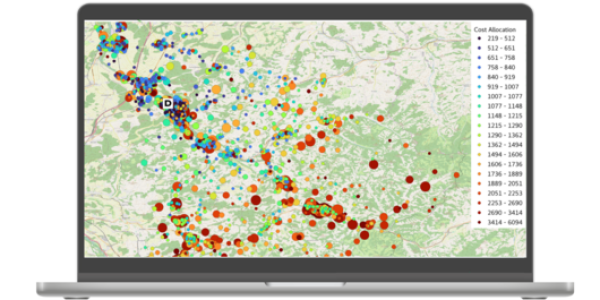
The algorithm applies cooperative game theory—specifically the “Happy Nucleolus” model, developed in partnership with the University of Bonn—to accurately calculate the cost of assigning each area group to a delivery network. Factors include:
• Time constraints and delivery urgency
• Distance from the depot
• Delivery density and volume fluctuations
Operational constraints and fleet capacity
Using the calculated costs, the system strategically assigns area groups to the combined or parcel-only network based on their cost-effectiveness and operational feasibility.
Greenplan’s core routing algorithm calculates intelligent routes for each network, using fixed routes for combined deliveries and dynamic routes for parcel deliveries. This hybrid approach accommodates fluctuations in parcel volume and optimises resource use during peak times. The resulting routes ultimately determine the boundaries of the sectors.
This stage conforms to the unique requirements of each customer. Tours are customised to individual delivery days, but additional customisations, analyses, and refinements are highly dependent on the business goals and agility of individual customers.
Smart Sectorisation is a first-of-its-kind solution that transforms how delivery networks are planned and optimised. By intelligently splitting parcels between networks, optimising routes, and dynamically designing delivery sectors, Greenplan delivers measurable improvements in cost efficiency, operational flexibility, and delivery performance.
With reliable delivery performance and lower operational expenses, customer satisfaction grows and budgets benefit. Greenplan’s newest capability promises significant savings for the post and parcel industry. As parcel volumes grow, a data-driven strategy for assignment and dispatch design is critical – and smart sectorisation is the solution.
(0.5 MB)
Searching for the WMS solution that fits you best?
We are proud that the EPG AURA Observer won the LogiMAT “Best Product 2026” award! Read this exclusive reprint to find out how our AI solution is shaping the future of logistics.


