
 Global
 English
 Español
 Português
 Deutsch
 English
 Français
 Italiano
 Nederlands
 Polski
 Čeština
 AE-English
 日本語
 AU-English
EPG (Ehrhardt Partner Group) is expanding its EPG ONE Supply Chain Execution Suite with a system-agnostic Order Management System (OMS) that connects incoming demand with operational fulfillment. Today, orders originate from many different sources at the same time, including ERP systems, online stores, customer portals, EDI, marketplaces, retail locations, file imports and manual entries in day-to-day operations. While this provides customers with greater flexibility, it often increases complexity within logistics operations. Different formats, fragmented system environments and manual order management decisions make it difficult to maintain an overview of which order should be processed, at what priority, from which inventory and at what time. This affects logistics service providers managing multiple customers and service levels simultaneously, as well as retail and industrial companies processing orders across multiple channels, locations and inventory pools. EPG ONE OMS consolidates this information in a central control layer and determines how orders should enter fulfillment based on clearly defined business rules. The solution connects to existing systems from different vendors and can be used independently of EPG’s other software solutions.
ERP systems, webshops, customer portals, marketplaces and EDI connections are only some of the sources from which orders reach companies today. At the same time, the corresponding inventory is often managed at different locations and in separate systems. As a result, planning and operations teams lack a reliable overall view, even though the individual warehouse and transportation processes are already extensively digitalized. Before an order can enter fulfillment, employees must first determine whether the required inventory is available and which operational process is best suited to meet the customer’s requirements. EPG ONE OMS creates this missing connection between demand and execution. The system establishes an overarching control layer that works with existing ERP and warehouse management systems from different vendors. A fully integrated EPG system landscape is not required. The system-agnostic architecture allows companies to introduce EPG ONE OMS without replacing their established operational solutions or implementing additional EPG products. At the same time, the new solution expands the EPG ONE Supply Chain Execution Suite at a crucial point in the fulfillment process. “An order management system should not stop at collecting and displaying orders. Its real value lies in using the available information to determine how an order should enter fulfillment,” explains Jens Heinrich, Principal Strategic Product Manager at EPG. “With EPG ONE OMS, we combine orders and inventory in one central view and apply clearly defined business rules to the subsequent process. This reduces manual coordination and gives companies much greater control over fulfillment across their existing system landscape.”
A Clear View Across System Boundaries
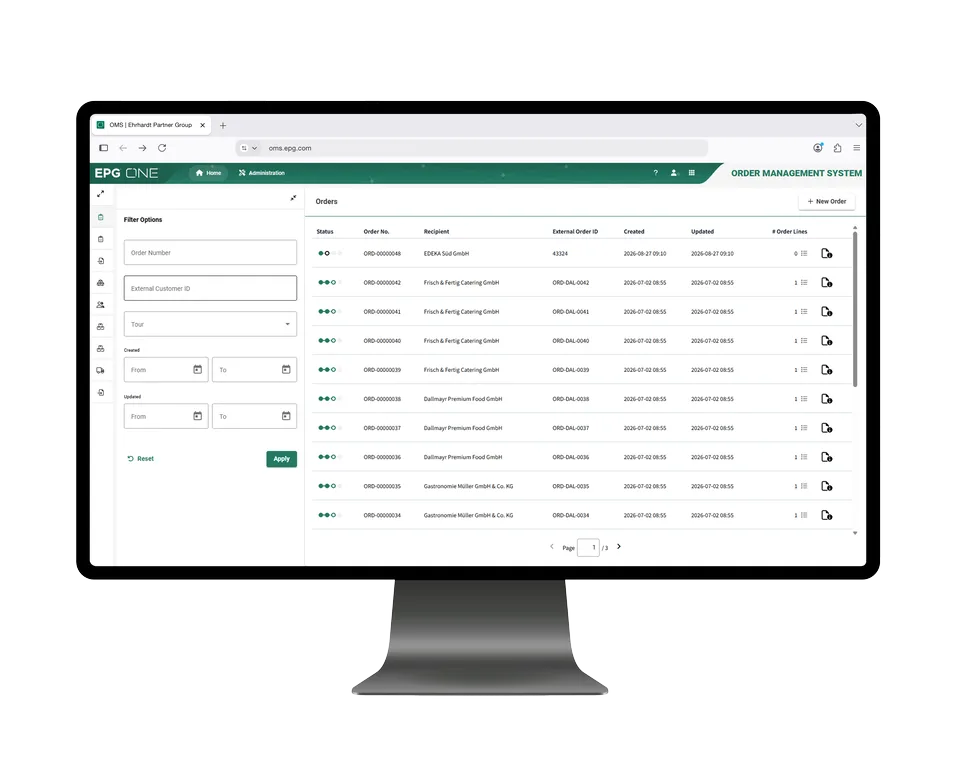
Incoming orders are consolidated in the central Order Hub. They can be transferred through an Order API or EDI connection, imported from CSV and Excel files or entered manually. This allows companies to manage traditional B2B and e-commerce business alongside further order channels and omnichannel scenarios. OMS supplements this order view with fulfillment-relevant inventory information from the connected systems. Planning, customer service and operations teams can therefore see which orders are awaiting fulfillment, where suitable inventory is available and whether an exception requires attention. Order statuses, priorities and subsequent process progress are also available centrally. For logistics service providers, this creates a common control level for different clients and service agreements without replacing the operational systems used for each account. Retail and industrial companies gain the same transparency across their sales channels, inventory pools and fulfillment structures. Before an order is released, OMS validates the underlying information. Depending on the process, this includes customer and address data, items, warehouse assignments, shipping methods and inventory details. Incomplete or incorrect orders are identified with a clear explanation so that exceptions can be resolved before they disrupt warehouse or shipping operations.
Fulfillment Decisions Based on Clear Rules
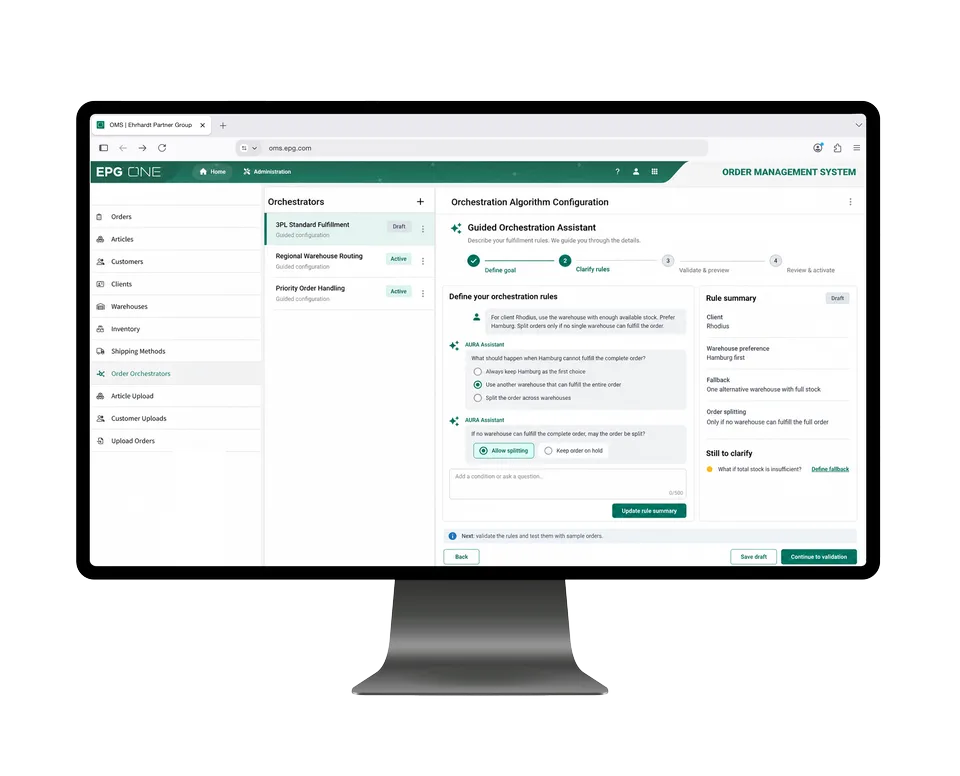
The consolidated view provides the basis for rules-based orchestration. Instead of deciding manually how each individual order should be processed, companies define the conditions that govern its path into fulfillment. Customer requirements, service-level agreements, shipping cut-offs, priorities and current inventory availability can all be incorporated. OMS uses these rules to determine when an order is released, which priority it receives and which downstream process should handle it. Urgent orders can be transferred directly to execution, while standard orders remain assigned to the appropriate processing schedule. The decision remains transparent because the underlying rule and the resulting status changes are documented within the system. As the solution develops, this logic will also support more extensive multi-warehouse scenarios. OMS will then be able to determine which location should fulfill an order, whether inventory from another site should be used and when an order needs to be split across several fulfillment locations.
For defined use cases, optional AI-supported capabilities will make it easier to configure new fulfillment rules. Rather than translating an operational requirement into a technical configuration first, users can describe the intended process in natural language. OMS then translates this description into the corresponding orchestration logic. A logistics service provider could specify, for example, that express orders for a particular customer received before a certain cut-off should be prioritized and assigned to the preferred location whenever sufficient inventory is available. The capability is provided directly within OMS and draws on technology from EPG’s AURA environment in the background. Companies do not need to deploy a separate AURA application or license to use it. This capability is part of the current OMS development and will initially be available for a limited number of defined use cases before being expanded to further scenarios.
Open Architecture for Existing IT Environments
OMS is designed to complement existing supply chain systems rather than replace them. Warehouse and transportation management solutions remain responsible for operational execution, while OMS provides the overarching view and decision logic. Its core order management and orchestration functions operate independently of EPG AURA and can be connected to solutions from EPG as well as systems from other vendors. Companies can introduce the solution step by step and initially focus on the processes in which fragmented information or manual coordination currently create the greatest effort. A continuous event log documents the order lifecycle beyond its release into execution. It records when an order was received, validated and orchestrated as well as when it was transferred to the responsible system. Customer service teams can provide more accurate information, while operations teams identify data issues, delays and potential SLA violations at an earlier stage.
EPG ONE OMS is being developed as part of EPG’s collaboration with Konoike Transport Co., Ltd., whose more than 140 years of hands-on logistics and 3PL experience provide an important source of operational knowledge for the solution. The collaboration takes place through Ehrhardt Konoike Solutions (EKS), a joint venture established by EPG and Konoike Transport Co., Ltd. in July 2025. At the EKS Co-Creation Hub and fulfillment site, both partners combine EPG’s software expertise with Konoike Transport’s practical understanding of complex logistics operations. The operational environment at EKS, where orders from different customers and process models are coordinated, allows practical requirements to flow directly into product development. “At EKS, we see every day how much coordination is required when order and inventory information is scattered across customers, departments and warehouse partners, a challenge I have seen firsthand, often even more pronounced in the multi-shipper warehouses I have worked with in Japan,” explains Hayato Kamitsuki, Managing Director at EKS. “The joint development of EPG ONE OMS addresses this challenge directly. It creates the transparency required to control fulfillment centrally while allowing companies to continue working with their established operational solutions.”
The Next Step in Smarter Connected Fulfillment
The first development stage focuses on centralized order and inventory visibility, data validation and rules-based orchestration. Planned additions include advanced multi-warehouse capabilities, order splitting and consolidation, TMS integration, returns processes and extended analytics. The AI-supported capabilities will also be expanded gradually. In the future, additional operational data and historical developments can provide greater context for fulfillment decisions as requirements become more complex. With OMS, EPG is closing the gap between incoming demand and operational execution. Companies gain an open control layer that brings together the information required for fulfillment and transfers orders into the appropriate processes according to clearly defined rules.

Aumente
la eficiencia
Elimine
los errores
Tenga
el control total