Global
  English
  Español
  Português
  Deutsch
  English
  Français
  Italiano
  Nederlands
  Polski
  Čeština
  AE-English
  日本語
日本語  AU-English


- Tags ai in logistics, supply-chain
Existing logistics software solutions reliably fulfill their role by executing processes, managing transactions, and ensuring stability. However, their view of operations remains system-specific. Real-world workflows, deviations, and situational interdependencies can only be captured and connected to a limited extent. In many cases, orientation is therefore created outside the systems through experience, coordination, and manual intervention.
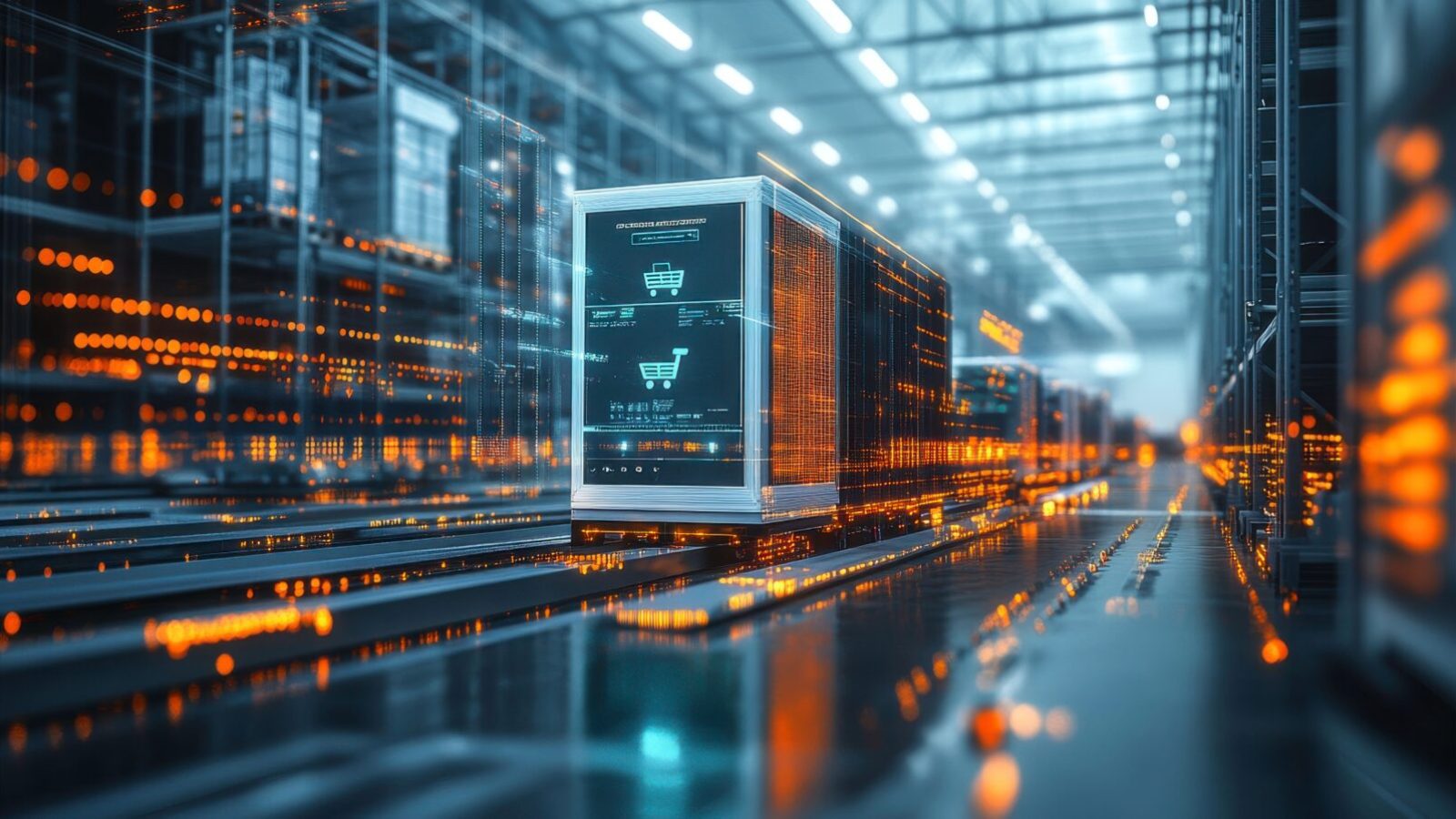
EPG AURA addresses precisely this gap. As an AI-native environment, AURA expands operational logistics with a higher-level intelligence layer. Physical operations, digital process information, and contextual knowledge are systematically connected and made available in context. Decisions no longer emerge from the user logic of individual applications, but from the actual logistical situation in ongoing operations.
When systems execute reliably, but orientation is missing
Warehouse management systems, transportation solutions, automation controls, and planning tools have formed the backbone of operational logistics for years. They are designed to execute processes reliably, represent system states, and ensure stability in day-to-day operations. Their strength lies in the consistent control of defined workflows.
These systems perform well as long as operational situations remain within expected patterns. Modern supply chains, however, are shaped by parallel events, short-term deviations, and dynamic interdependencies. Decisions no longer unfold in isolation, but simultaneously across multiple processes and systems.
A change in priority does not affect a single order alone. It influences cycle times, workforce deployment, automation utilization, and transportation flows at the same time. Trade-offs between service level, efficiency, stability, and capacity emerge situationally. Traditional systems capture these interconnections only in fragments. Real-world workflows, contextual information, and operational interactions often remain outside the system’s view.
As a result, decisions increasingly take shape outside the systems. Employees must consolidate information, interpret it, and assess it, often under time pressure and with incomplete transparency. As complexity rises, this lack of contextual awareness becomes the limiting factor in operational control.
Why more rules are not the answer
A seemingly obvious approach is to further refine existing operational systems. Additional rules, more detailed parameters, and new exception logic are intended to help manage rising complexity. In practice, however, this path rarely creates greater orientation.
Rule-based architectures are designed to handle known situations efficiently. But when multiple deviations occur at once or trade-offs emerge, they reach structural limits. Every additional special rule increases the complexity of system logic, makes adjustments more difficult, and slows response times in day-to-day operations.
The gap between operational reality and system representation continues to grow. What is missing is not another rule or an extra parameter, but an environment that can interpret situations in context. Operational intelligence does not come from more logic, but from a deeper understanding of interdependencies in ongoing operations.

Intelligence beyond rigid system logic
This form of operational intelligence is enabled by EPG AURA. AURA is an AI-native environment that acts as a higher-level intelligence layer above existing operational systems. It complements applications across warehousing, transportation, and material flow with an additional level of perception, contextual interpretation, and decision support. The goal is to manage operational logistics not solely through transactional feedback, but by continuously bringing together real events, data streams, and contextual information and making them usable for decision-making.
At the center of EPG AURA is the Cognitive Core, the technical and intelligent foundation of the environment. It combines an AI-native technology backbone with a semantic data model in which operational information from different systems is interconnected. Data from warehouse management, material flow control, workforce management, or transportation processes is not processed in isolation, but interpreted in context. This creates a consistent, situation-dependent real-time view of the operational supply chain.
To base operational decisions not only on system messages but on what is actually happening on the warehouse floor, EPG AURA expands the digital process view with real operational events. This perception layer is represented by the AURA Observer. The Observer uses existing camera infrastructure as a data source and captures operational activity directly in the physical warehouse environment. Through intelligent video analytics, movements, interactions, and deviations are detected in real time and translated into structured events. Analysis runs continuously, in a privacy-compliant way, without traditional video surveillance or manual review. Operational conditions become objectively and systemically measurable for the first time.
Based on current status information from ERP, WMS, TMS, and other connected systems, the AURA Orchestrator takes over the orchestration of logistics processes. Its purpose is to ensure on-time execution and prepare operational decisions in a situation-aware manner. All available data sources can be leveraged and converted into concrete recommendations or alerts. Orchestration can be supportive in an augmented approach or fully autonomous. In both cases, decisions can be dynamically adapted to real events in ongoing operations.
With the AURA Communicator, interaction between people and systems becomes contextual and dialogue-based. Information is delivered depending on the situation, without users having to navigate through individual applications or interfaces. This includes queries on process and system status, stored work and packing instructions, guidance on maintenance or repair activities, and updates on current order progress. The AURA Communicator supports daily operational work and reduces reliance on deep system-specific expertise.
Agentic, integrated, resilient, adaptive
EPG AURA brings together four qualities that are essential for modern, AI-supported Supply Chain Execution. They do not stem from individual features, but from the interaction within an AI-native environment.
- Agentic: AURA operates in an agentic way by continuously observing operational situations, interpreting them in context, and deriving possible courses of action through specialized AI capabilities. Decisions are not predefined statically, but prepared and adjusted based on the situation.
- Integrated: At the same time, the environment is consistently integrated. Operational data, processes, and systems are consolidated into a shared view. Information is not isolated within individual applications, but connected and provided within its logistical context.
- Resilient: This integration forms the foundation for resilience. Deviations and disruptions are detected early, their impact is assessed, and alternative options become visible. Operational control remains effective even under dynamic conditions.
- Adaptive: Beyond that, EPG AURA is designed to be adaptive. Its modular architecture makes it possible to expand and evolve capabilities step by step without interrupting existing processes. The environment adjusts to changing requirements and develops alongside the supply chain.
AGENTIC
Powered by AI agents that act proactively and support the continuous optimization of operational processes.
UNIFIED
Connecting all processes, data, and stakeholders in one intelligent environment.
RESILIENT
Ensuring stability, agility, and robustness within global supply chain operations.
ADAPTIVE
Continuously learning, analyzing dynamic supply chain requirements, and enabling rapid adaptation.
From perception to impact
EPG AURA follows a clear principle: perceive operational processes, interpret information semantically, and prepare decisions in context. The environment connects real events from the operational world with digital process information and delivers them in a way that makes them immediately usable in day-to-day execution.
AURA does not operate as an isolated AI feature, but as an integrated environment. Perception, analysis, and decision support work together, built on a shared operational view. Information is provided in context and prepared so that daily operational decisions can be made without requiring deep, system-specific expertise.
Depending on the situation, AURA supports different levels of automation, from assisted scenarios to more automated execution within clearly defined boundaries. Companies remain in full control of how far decisions are automated. AURA creates transparency across interdependencies, highlights options for action, and enables organizations to stabilize and evolve operational processes in a targeted way without disrupting existing structures.
Foundation for continuous evolution and new applications
EPG AURA is designed as a modular, AI-native environment that enables an easy entry into the use of intelligent capabilities. The functions bundled within AURA are not tied to a single product, but operate as a shared intelligence layer through which existing solutions can be enhanced and new applications can be developed.
Existing products within the EPG ONE Suite remain fully intact in their respective roles and are selectively supported by AURA. They can be expanded step by step with intelligent capabilities, for example to increase operational efficiency or to simplify daily work through contextual decision support. This creates an environment that enables ongoing innovation without disrupting proven structures.
Conclusion: A new era of Supply Chain Execution
With EPG AURA, operational logistics expands beyond traditional system logic with an AI-native intelligence layer. Intelligence is not introduced as an additional feature, but as an integral part of an environment that systematically connects physical operations, digital process information, and contextual knowledge.
Operational decisions are no longer based solely on transactional system feedback, but on a contextual interpretation of what is actually happening in ongoing operations. Information is provided in a way that enables employees to act effectively without requiring deep, system-specific expertise.
EPG AURA establishes a new foundation for Supply Chain Execution. Existing systems remain in place and are selectively enhanced. Operational processes become more transparent, decisions more traceable, and execution more adaptable. This creates a form of Supply Chain Execution that combines stability and flexibility in day-to-day operations.

The next step: placing operational intelligence into your own context
Many companies face the challenge of evolving their existing Supply Chain Execution without destabilizing proven systems and operational workflows. Operational intelligence does not emerge through a complete system replacement, but through the targeted extension of existing architectures with a shared, context-based operational view.
Getting started begins with a structured assessment:
- Where are operational decisions made today under time pressure and with incomplete information?
- In which situations is the connection missing between real-world events and the digital process picture?
- Which trade-offs are resolved manually today, even though they could be made systemically visible?
EPG AURA is designed as an AI-native environment that can be integrated step by step into existing system landscapes. Through a joint exchange, it becomes possible to evaluate where additional perception, contextual interpretation, and decision support create the greatest value, and how this approach can be meaningfully embedded into current processes.
If you would like to explore what such an assessment could look like for your supply chain, get in touch with us. Our experts will support you from the initial analysis through to the development of a robust, future-ready approach.